What a Six-Week Training Block Should Include
A good six-week training block has a clear shape: a baseline before you start, about four build weeks where you add small amounts of work, one lighter deload week, and a retest and review at the end. Six weeks is long enough to see a trend and short enough to change the plan if it is not working. No block guarantees a result, and a body scan is best compared over eight to twelve weeks. This is a general example, not a personal programme or injury advice. Everest coaches in person in Christchurch and Rolleston and online.
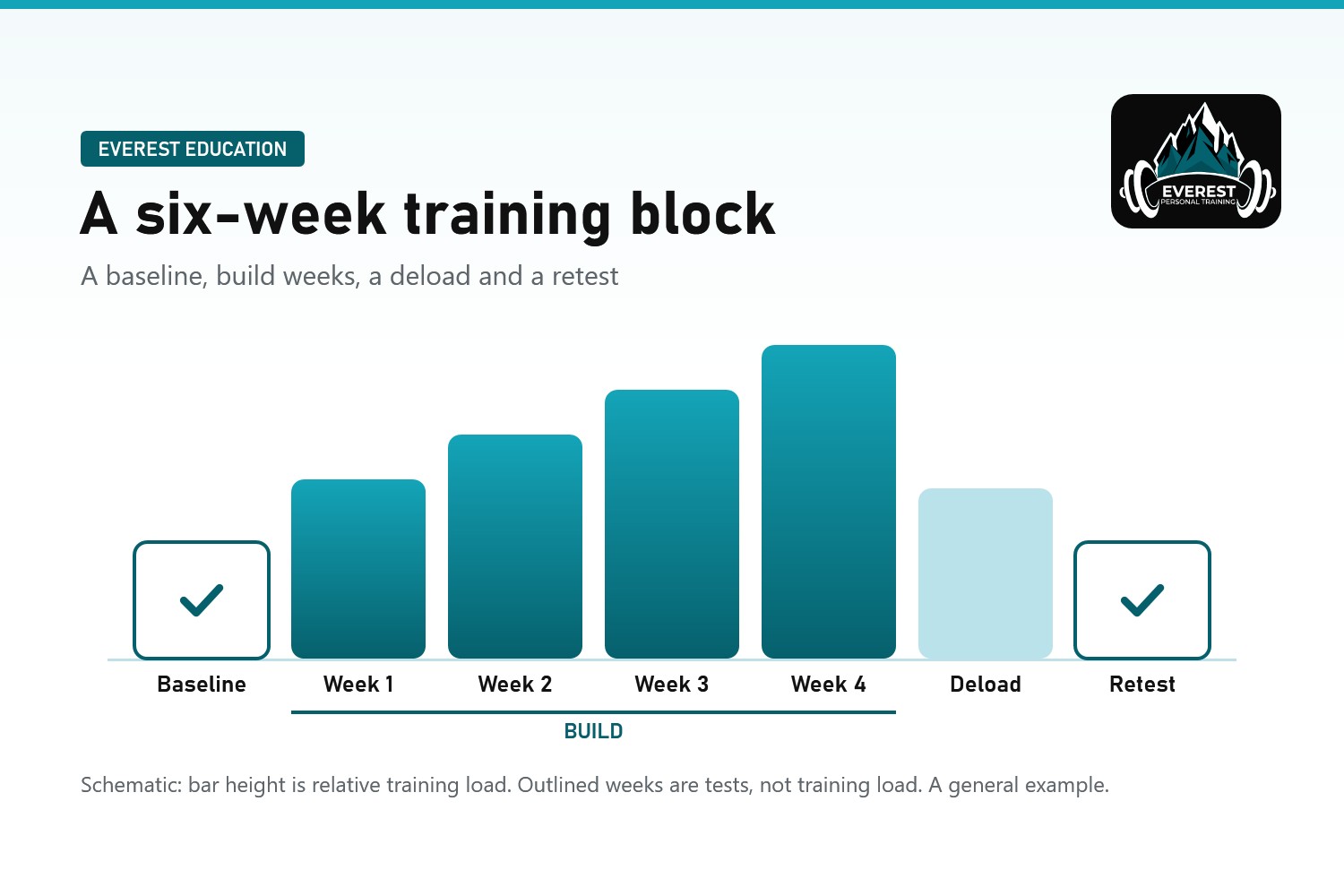
If you are comparing programmes, one of the most useful questions you can ask is: what happens across the weeks? A good six-week training block has a clear shape. There is a baseline before you start, about four build weeks where you add small amounts of work, one lighter deload week, and a retest and review at the end.
That shape is what separates a plan from a pile of workouts. It tells you where you started, what changed, and what to do next.
This is a general example, not a personal programme. It is not injury or medical advice, and no block guarantees a particular result. If you have an injury or a health condition, speak to your GP or a physio first.
Why six weeks
There is nothing magical about six. Four to eight weeks is a common length for a block. Six works well because it is long enough to repeat each session several times, which is what you need to see a trend, and short enough that if the plan is wrong you have lost weeks, not months.
Established guidance describes resistance training as a planned progression, with load, volume and exercises varied over time rather than repeated unchanged. A block is how you put that into practice.
Week 0: the baseline
Before week one, set a starting point. Without one, there is nothing to compare at the end. A baseline does not need to be elaborate:
- A movement check. How do you squat, hinge, push and pull today? Where does it feel awkward?
- A simple rep test on one or two lifts at a weight you can control, not a one-rep maximum.
- Two or three measures that matter to you. That might be eight clean reps at a set weight, how you manage the stairs, or how many sessions you manage in a normal week.
- The context: your goals, your week, the equipment you can reach, and any injuries or limits.
- How you feel. Sleep, energy and soreness, noted so you can see how they move.
Write it all down. These notes are the most valuable thing in the block.
The build weeks: weeks 1 to 4
The build weeks do the work, and they are deliberately simple.
- Keep the main movements the same each week. If you change everything, you cannot tell what worked.
- Change one thing at a time. Add a repetition, then a small amount of weight, or a set. Guidance on progression suggests small increases, roughly in the range of two to ten percent, once you can beat the target reps in two sessions in a row.
- Use effort as a guide. “Reps in reserve” is how many more repetitions you could have done. Early weeks sit comfortably, with three or so in reserve. By week four most main sets finish with one or two in reserve.
- Respect volume. Research on weekly sets finds that, up to a point, more sets per muscle group are associated with more muscle gain. The catch is that you only benefit from what you can recover from, so more is not automatically better.
- Look after the basics. Sleep, food and how you manage the rest of your week decide how well you recover. Everest programmes track nutrition habits in the app alongside sessions.
The deload: week 5
A deload is a planned lighter week. You keep the same movements but cut the amount of work, for example fewer sets or lighter weights. It is not a week off.
The purpose is to recover and consolidate before the retest, and to avoid grinding week after week. It is worth being honest about the evidence. Deloads are standard coaching practice, but the research on exactly how to do them is limited. A scoping review of strength sports found that short periods of hard training can produce short-term overreaching that may be useful, that long stretches of high volume or intensity can lead to a longer-lasting drop in performance, and that more research is needed to give practitioners firm guidance.
If a deload feels like a waste because you are progressing well, that is usually the moment it is doing its job.
Retest and review: week 6
Now repeat the baseline: the same movements, the same rep test, the same measures, and a look at the same notes.
Review three things:
- What changed. Reps, weight, how movements feel, how you coped with the week.
- What got in the way. Missed sessions, poor sleep, a niggle, a busy fortnight.
- What happens next. Repeat the block with adjustments, change the focus, add a day, or take a short break.
A retest is information, not a verdict. A flat block still tells you something useful about what to change.
Where a body scan fits
A scan can give a baseline for body composition, such as muscle mass and body fat, at the start of a block. Everest Premium includes one at the start of each six-week block.
The honest limit is that changes in body composition over six weeks can be small, and readings move with hydration, food and time of day. That is why we compare scans over eight to twelve weeks, under similar conditions, rather than treating a single six-week change as a verdict. A scan is one input alongside your training notes. Read more in body scans: what they measure and how to prepare, or see body scans in Rolleston.
Questions to ask about any programme
- Is there a baseline, and how is progress measured?
- Does the plan repeat the main movements so you can compare?
- Is there a planned lighter week?
- What happens at week six, and who adjusts the plan?
- How does it fit your week and your equipment?
If you are coming back after a break, start with how to return to training after time off before a full block.
How Everest uses blocks
Everest programmes are built around this kind of shape, adjusted for the person. Coaching is in person in Christchurch and Rolleston and online for everyone else. See personal training at Everest for how the coaching works.
Want to see how this looks in practice? See the programmes, or ask us a question.
Frequently asked questions
How long should a training programme be?
There is no single right length. Four to eight weeks is common for a block of training. Six weeks is long enough to repeat each session several times and see a trend, and short enough to change the plan if it is not working.
What is a deload week?
A planned lighter week, usually with fewer sets or lighter weights but the same movements, so you recover before the next block. It is not a week off. Deloads are standard coaching practice, although the research on exactly how to do them is limited.
Should I change all my exercises every six weeks?
No. Keep the main movements so you can compare one block with the next, and change the details such as rep ranges, set numbers or variations. Changing everything makes it hard to tell what worked.
How do I know if a six-week block worked?
Compare the retest with your baseline, using the same movements, the same rep test and the same measures, alongside notes on sleep, energy and attendance. No block guarantees a particular result, and a flat block still tells you something useful about what to change.
Do I need a body scan in a six-week block?
No. A scan can give a baseline for body composition, but changes over six weeks can be small, so scans are better compared over eight to twelve weeks under similar conditions. Everest Premium includes a scan at the start of each six-week block.
Sources
- American College of Sports Medicine (2009). Progression models in resistance training for healthy adults. Medicine & Science in Sports & Exercise, 41(3), 687-708. doi.org/10.1249/MSS.0b013e3181915670
- Schoenfeld, B.J., Ogborn, D. & Krieger, J.W. (2017). Dose-response relationship between weekly resistance training volume and increases in muscle mass: a systematic review and meta-analysis. Journal of Sports Sciences, 35(11), 1073-1082. doi.org/10.1080/02640414.2016.1210197
- Bell, L., Ruddock, A., Maden-Wilkinson, T. & Rogerson, D. (2020). Overreaching and overtraining in strength sports and resistance training: a scoping review. Journal of Sports Sciences, 38(16), 1897-1912. doi.org/10.1080/02640414.2020.1763077
- Helms, E.R., Cronin, J., Storey, A. & Zourdos, M.C. (2016). Application of the repetitions in reserve-based rating of perceived exertion scale for resistance training. Strength & Conditioning Journal, 38(4), 42-49. doi.org/10.1519/SSC.0000000000000218
Ready to put this into practice?
Whether you're starting out or chasing a goal, we'll point you to the right programme, coach or pathway.