How to Return to Training After Time Off: A Realistic First Three Weeks
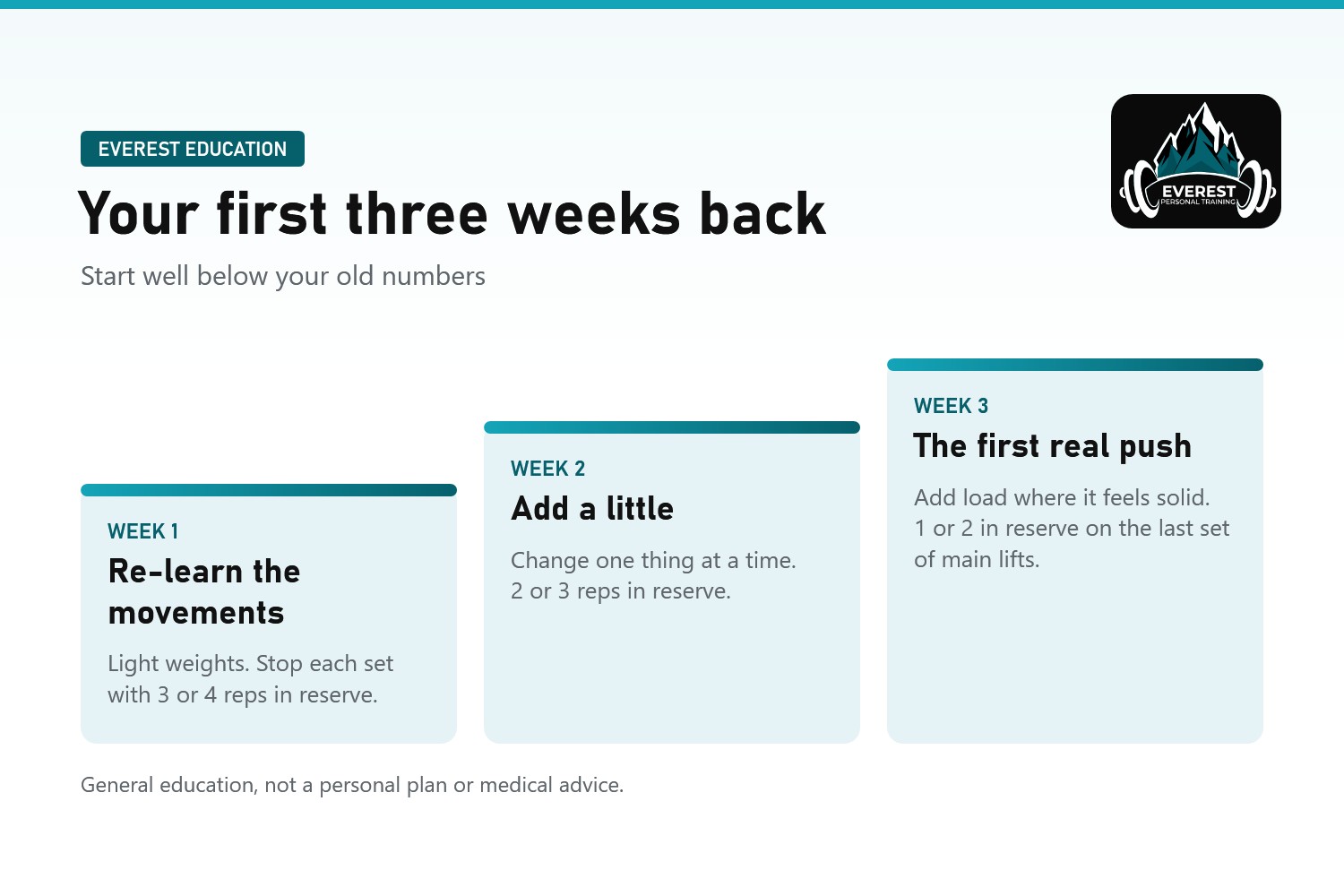
Do not resume where you left off. Start well below your old numbers, train two or three short full-body sessions a week, and change one thing at a time over three weeks: re-learn the movements in week one, add a little in week two, and push a bit harder in week three. Strength can come back quickly after a break, but your memory of your old weights runs ahead of what your body is ready for today. This is general education, not injury, post-natal or medical advice. Everest coaches in person in Christchurch and Rolleston and online.
If you have been away from training for a few weeks, a few months or a few years, the question is rarely whether to go back. It is how. The short answer: do not pick up where you left off. Start well below your old numbers, train two or three short sessions a week, and change one thing at a time over the first three weeks.
That applies whether the break was an illness, a new baby, a busy season at work, a move, or simply drifting out of the habit. This is general education, not medical advice. If your break was because of an injury, surgery or a health condition, or you are post-natal, speak to your GP or a physio before you start.
If you are starting from scratch rather than returning, the beginner strength training checklist and strength training for beginners are a better place to begin.
Why you cannot pick up where you left off
Fitness does not vanish in a few weeks, and it does not stay put either. Reviews of training breaks find that strength tends to hold up better than people fear over a short break, with limited declines under about four weeks, and then falls further the longer you are away. How much it falls depends on your training history, your age and how long the break was.
So the honest picture sits in the middle. You have not lost everything, and you are not where you were. What tends to lag most is not the number on the bar. It is your tolerance for work, how quickly you recover between sessions, and your habit of turning up.
There is good news. Studies of people who retrain after a long break find that muscle responds quickly, that some of the earlier gains are retained through the break, and early research suggests muscle may keep a molecular memory of earlier training. That is encouraging, and it is also the trap. The first session back feels good, you do what you used to do, and you are sore and flat for a week.
That soreness is worth understanding. The research on the “repeated bout effect” shows that a single session of eccentric, muscle-lengthening exercise protects the muscle against damage in later sessions. It is one reason the first sessions back are best kept gentle: they start the adaptation that makes the next ones easier.
Before week one: set up a return you can keep
A plan you can follow in a normal week beats an ideal one you abandon in the second.
- Pick two or three days you can realistically hold, and protect them like appointments.
- Keep sessions to 30 to 45 minutes. Short and regular is the aim.
- Decide where. A gym, a home setup or bodyweight only all work for the first three weeks.
- Write down what you do. Exercises, weights, reps and how it felt. Notes are how you stop guessing.
- Set a modest goal. Health guidelines for adults suggest muscle-strengthening on two or more days a week, so two sessions a week is a genuine target.
Week 1: re-learn the movements
Week one is about moving well again, not about proving anything. Aim for two sessions, with a third short one only if you feel fresh.
A simple full-body session might include:
- a squat or sit-to-stand for your legs
- a hinge, such as a hip hinge or Romanian deadlift
- a push, such as a press-up or dumbbell press
- a pull, such as a row
- a carry or a core movement to finish
Do two sets of eight to ten of each, using weights well below your old ones. A useful guide is “reps in reserve”: the number of repetitions you could still have done. Aim to stop each set with three or four in reserve. You should finish feeling you could have done more. That is the point.
On other days, walk. Expect some soreness and do not chase it.
Week 2: add a little
Now repeat the same movements and ask slightly more of them. Change one thing at a time:
- add a repetition to each set, or
- add a small amount of weight, or
- add a third set to one or two movements.
Aim for two or three reps in reserve. If your technique slips as it gets harder, hold at the same level until it feels solid. If you felt fresh in week one, a third session is reasonable now.
Week 3: the first real push
In week three, add load or reps on the movements that feel solid, and let the last set of your main lifts get closer to hard, finishing with one or two reps in reserve. Leave the rest alone.
At the end of the week, review it:
- How was your sleep and energy on the days after sessions?
- Did soreness settle within a couple of days?
- Do your notes show more reps or weight than week one?
- Did you turn up for most of the sessions you planned?
Then decide: carry on with the same plan, hold where you are for another week, or get help refining it. When you are ready for more structure, see what a six-week training block should include.
How to know it is working
- You finish sessions with energy left, not wiped out.
- Soreness is manageable and settles within a few days.
- Your notes show small, steady increases.
- The movements feel smoother and more familiar.
- You are turning up most weeks.
Notice more than the scale. In three weeks, how you move and how consistently you train tell you far more than your weight will.
The mistakes that derail a return
- Resuming your old programme. It was built for a body that was fully trained, not the one you have today.
- Testing a heavy lift in week one. There is nothing to prove yet.
- Going from nothing to six days a week. Enthusiasm is not recovery.
- Skipping the warm-up because you feel keen.
- Ignoring a niggle. Soreness is one thing. Sharp or lingering pain is another.
- Comparing yourself with your old self. Compare this week with last week.
When to ask for help
Speak to your GP or a physio first if you have had an injury, surgery or an illness, if you are post-natal, if you have a health condition, or if something hurts in a way that does not feel like normal soreness.
A coach tends to help when you want a plan built around your week and your equipment, your technique checked, someone to notice when it stops working, or accountability that does not rely on willpower. Everest coaches in person in Christchurch and Rolleston and online for everyone else. See personal training at Everest and the programmes for how that works.
Want a plan for your return? Tell us how long you have been off and what your week looks like, and we will suggest where to start. Get a plan for your return.
Frequently asked questions
How long does it take to get back to where I was?
It depends on how long you were off, how long you had been training and your age. Research suggests strength can come back quickly and that some earlier adaptations are retained during a break, but a sensible return still takes weeks, not days. Judge it by your own notes, not by where you used to be.
Should I start with the same weights I used before?
No. Start lighter than you think you need to and finish each set with several repetitions left. The numbers you remember are from a body that was fully trained. Your starting point is where you are today.
Is it normal to be sore when I get back?
Some soreness in the first week is common. It usually peaks a day or two after a session and eases over the following days. Starting light keeps it manageable. Sharp pain, pain in a joint or soreness that does not settle is different, so stop and speak to your GP or a physio.
How many sessions a week should I do when I return?
Two or three short full-body sessions is plenty for the first three weeks. Health guidelines for adults suggest muscle-strengthening on two or more days a week, so two sessions is a real target, not a compromise.
When should I speak to a GP before returning?
If you have had an illness, injury or surgery, are post-natal, have a health condition, or feel unwell during exercise, speak to your GP or a physio first. This guide is general education and cannot replace advice about your own body.
Sources
- Mujika, I. & Padilla, S. (2000). Detraining: loss of training-induced physiological and performance adaptations. Part I: short term insufficient training stimulus. Sports Medicine, 30(2), 79-87. doi.org/10.2165/00007256-200030020-00002
- Mujika, I. & Padilla, S. (2000). Detraining: loss of training-induced physiological and performance adaptations. Part II: long term insufficient training stimulus. Sports Medicine, 30(3), 145-154. doi.org/10.2165/00007256-200030030-00001
- Bosquet, L., Berryman, N., Dupuy, O. et al. (2013). Effect of training cessation on muscular performance: a meta-analysis. Scandinavian Journal of Medicine & Science in Sports, 23(3), e140-e149. doi.org/10.1111/sms.12047
- Staron, R.S., Leonardi, M.J., Karapondo, D.L. et al. (1991). Strength and skeletal muscle adaptations in heavy-resistance-trained women after detraining and retraining. Journal of Applied Physiology, 70(2), 631-640. doi.org/10.1152/jappl.1991.70.2.631
- Seaborne, R.A., Strauss, J., Cocks, M. et al. (2018). Human skeletal muscle possesses an epigenetic memory of hypertrophy. Scientific Reports, 8, 1898. doi.org/10.1038/s41598-018-20287-3
- McHugh, M.P. (2003). Recent advances in the understanding of the repeated bout effect: the protective effect against muscle damage from a single bout of eccentric exercise. Scandinavian Journal of Medicine & Science in Sports, 13(2), 88-97. doi.org/10.1034/j.1600-0838.2003.02477.x
- Helms, E.R., Cronin, J., Storey, A. & Zourdos, M.C. (2016). Application of the repetitions in reserve-based rating of perceived exertion scale for resistance training. Strength & Conditioning Journal, 38(4), 42-49. doi.org/10.1519/SSC.0000000000000218
- Bull, F.C., Al-Ansari, S.S., Biddle, S. et al. (2020). World Health Organization 2020 guidelines on physical activity and sedentary behaviour. British Journal of Sports Medicine, 54, 1451-1462. doi.org/10.1136/bjsports-2020-102955
Ready to put this into practice?
Whether you're starting out or chasing a goal, we'll point you to the right programme, coach or pathway.