Hip Flexors, Core and Balance: The Missing Link in Better Movement
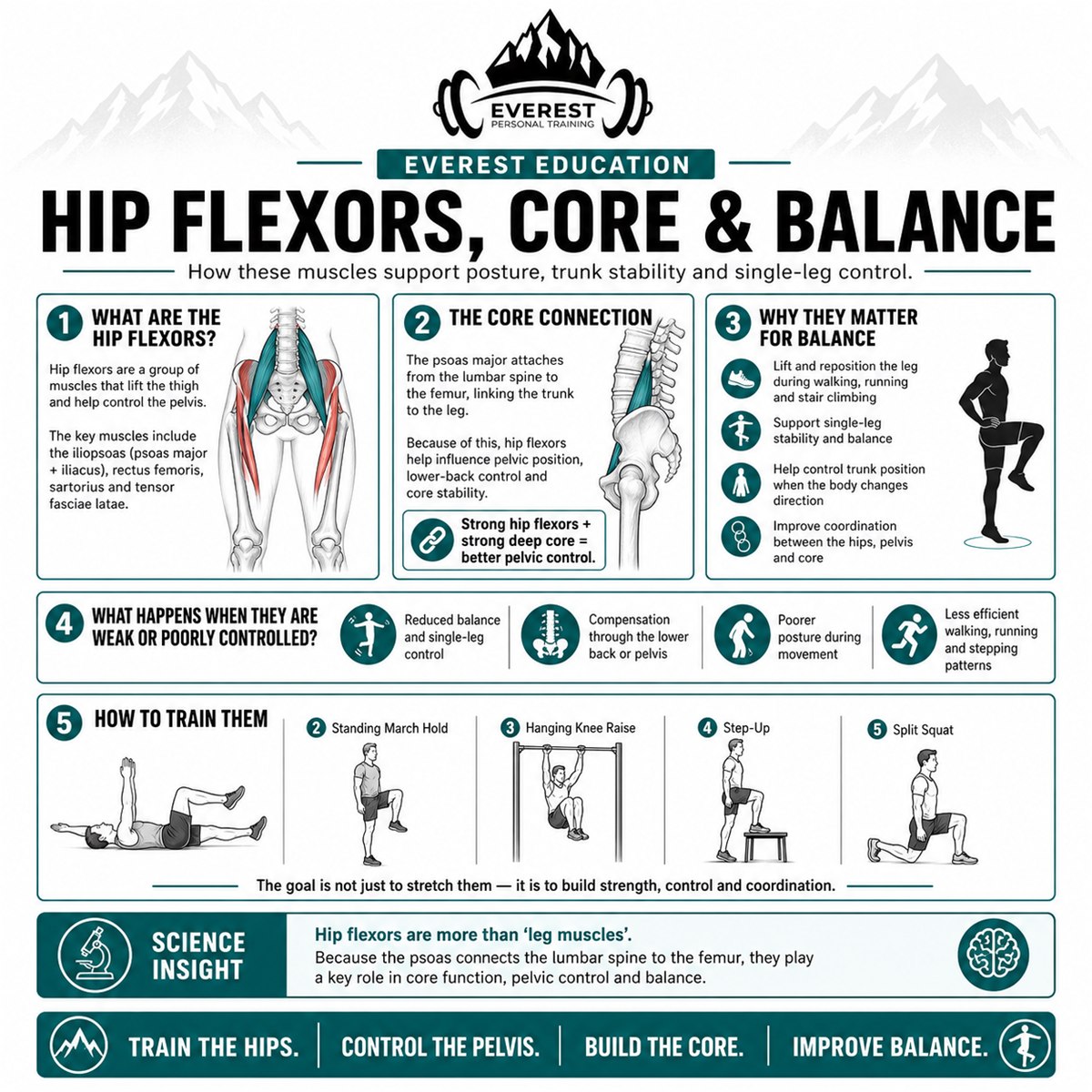
The hip flexors include iliacus, psoas major, rectus femoris, sartorius and tensor fasciae latae. Psoas major matters most because it connects the lumbar spine directly to the femur, which links hip flexor function to pelvic position, lower back control, walking, running, stair climbing and balance. Weak or poorly controlled hip flexors create compensation through the pelvis, lumbar spine, knees and hamstrings. The answer is usually not more stretching but building strength, control and coordination through the range you already have.
Ask someone about their hip flexors and you will usually hear the same sentence: they are tight, and they stretch them. Often for years. Often with the tightness returning within a day.
The anatomy explains why that loop never closes.
What the hip flexors actually are
The hip flexors are a group, not a muscle. They include iliacus, psoas major, rectus femoris, sartorius and tensor fasciae latae.
Psoas major is the one worth understanding properly, because it is the only muscle in the body that connects the lumbar spine directly to the femur. It runs from your lower back, through the pelvis, and attaches to the inside of your thigh bone.
Why that connection changes everything
Because psoas spans the spine and the leg, hip flexor function is not just about lifting your knee. It is tied to pelvic position, lower back control, walking, running, stair climbing, balance and trunk stability.
That is a lot of load on one connection. When it works well, the pelvis sits where it should and the spine is left alone to do its job. When it does not, the body finds another way, and that is where the trouble starts.
What “tight” usually means
A muscle can feel tight for two very different reasons. It can be genuinely short. Or it can be working overtime to stabilise a position it is not strong enough to control, and reporting that effort as tension.
For most people who sit for a living, the second is far more common. Stretching a muscle that is straining to hold you together provides about twenty minutes of relief and changes nothing underneath.
Where the compensations show up
Poorly controlled hip flexors rarely announce themselves at the hip. They show up as compensations through the pelvis, the lumbar spine, the knees and the hamstrings. Chronic hamstring tightness in particular is frequently a pelvic position problem wearing a disguise.
Balance is the other place it appears. Standing on one leg, stepping, or changing direction requires the nervous system to control hip position continuously. If the hip cannot hold that position under load, balance degrades, and it degrades first in exactly the situations where falling matters most.
What to do this week
- Add controlled knee drive. Marching patterns, done slowly, with the pelvis staying level.
- Train single-leg stance. Thirty seconds a side, then progress by closing your eyes or adding a reach.
- Use dead bugs properly. Slowly, with the lower back staying in contact with the floor. The moment it lifts, the set is over.
- Load step-ups with control. Drive up, then lower yourself back down under control rather than dropping.
- Stretch if you want, but do not stop there. Range you cannot control is not range you own.
The Everest takeaway
The goal is not looser hips. It is hips that are strong, mobile and coordinated enough that your spine, knees and balance stop compensating for them.
Not sure whether yours are tight or just working too hard? An Everest movement assessment tells the difference, and the programme that follows addresses the one you actually have. Enquire now.
Frequently asked questions
Why do my hip flexors feel tight even though I stretch them?
A muscle can feel tight because it is genuinely short, or because it is working hard to stabilise something it is not strong enough to control. The second is far more common in people who sit a lot, and stretching does not address it. Strength and control work through range usually does more than another stretch.
What does the psoas actually do?
Psoas major runs from the lumbar spine to the femur, making it the only muscle connecting the spine directly to the leg. That gives it a role in hip flexion, pelvic position and lumbar spine control, which is why it influences walking, running, stair climbing and balance rather than just lifting your knee.
How do I improve my balance?
Balance is a nervous system skill, so it improves with practice under progressively harder conditions. Single-leg stance, controlled step-ups, marching patterns and slow change of direction all train it. Strength through the hip and trunk gives the nervous system something to work with.
Ready to put this into practice?
Whether you're starting out or chasing a goal, we'll point you to the right programme, coach or pathway.