Understanding Your Metabolism: The Engine Behind Training, Energy and Body Composition
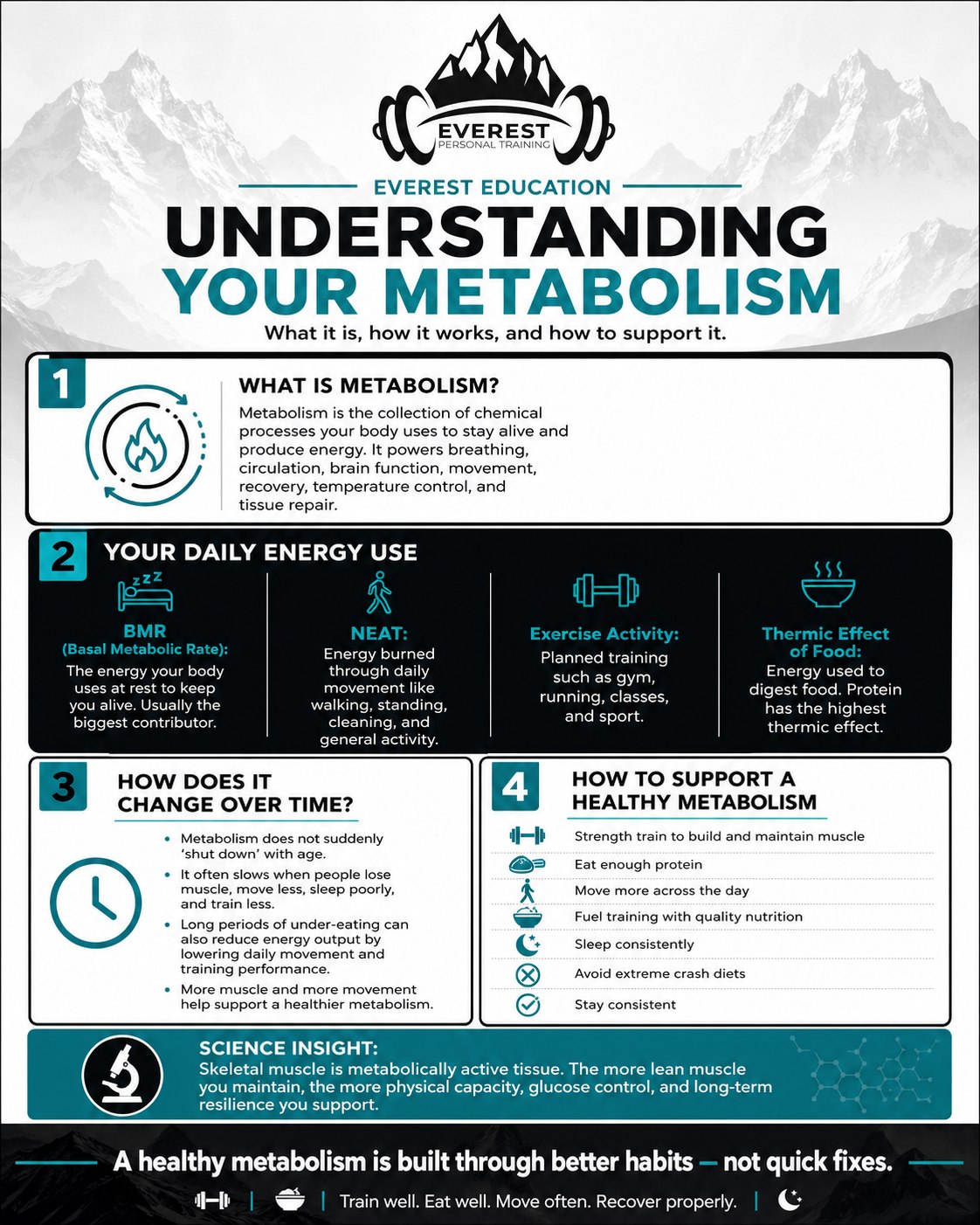
Metabolism is the full set of chemical processes that turn food, oxygen and stored energy into usable energy. Daily energy use has four parts: basal metabolic rate, non-exercise activity, planned exercise and the thermic effect of food. Metabolism does not shut down with age; it usually slows because muscle mass, daily movement and training intensity decline. The levers that matter are building and keeping muscle, eating enough protein, moving often, sleeping consistently and not crash dieting.
If you have ever been told you have a “slow metabolism”, you were probably given the least useful explanation available. Metabolism is not a single dial that runs fast in some people and slow in others. It is the entire chemical operation that keeps you alive, and almost every part of it responds to what you do.
What metabolism actually is
Metabolism is the collection of chemical processes your body uses to convert food, oxygen and stored energy into usable energy. That energy powers breathing, circulation, brain function, movement, temperature control, immune activity and tissue repair. It is running right now, while you read this, and the vast majority of it has nothing to do with exercise.
Where your energy actually goes
Daily energy expenditure breaks into four parts.
Basal metabolic rate (BMR) is what your body uses at rest simply to keep you alive. For most people this is the largest single contributor by a wide margin.
Non-exercise activity thermogenesis (NEAT) is everything you burn through daily movement that is not formal training: walking, standing, cleaning, carrying, fidgeting. NEAT varies enormously between people and is the part most affected by a desk job.
Exercise activity is planned training. It matters, but it is usually a smaller slice than people assume.
The thermic effect of food is the energy used to digest and process what you eat. Protein has the highest thermic effect of the three macronutrients.
Why it looks like it slows down
The common story is that metabolism collapses somewhere in your thirties. What actually happens is quieter and more fixable.
People lose muscle mass as they age, largely because they stop training in a way that demands it. They move less across the day as work and life get more sedentary. They sleep worse. They train less intensely. Each of those reduces daily energy output, and together they add up to a real change that gets blamed on a birthday.
Long periods of under-eating do the same thing from the other direction. Sustained aggressive dieting tends to cost you muscle and quietly reduce how much you move, so your output falls to meet your intake.
Why this matters for your training
Skeletal muscle is metabolically active tissue. It is also the main site your body uses to store and dispose of glucose. Building and keeping muscle is therefore not a cosmetic goal. It supports your daily energy output, your blood sugar control, your physical capacity and, over a long enough timeline, your independence.
This is why Everest programmes are built around progressive resistance training rather than chasing calorie burn in a session. The session is the signal. The muscle you keep is the asset.
What to do this week
- Strength train two to three times. Progressive resistance work is the most reliable lever you have on muscle mass.
- Get 25 to 40g of protein into each main meal. Spread across the day rather than loaded into dinner.
- Add movement outside training. A daily walk, taking the stairs, standing more. NEAT is the most underrated variable here.
- Sleep consistently. Same window most nights beats a perfect night once a week.
- Stop crash dieting. Sustained heavy restriction costs you the exact tissue that supports your energy output.
The Everest takeaway
A healthy metabolism is built through better habits, not quick fixes. Train well, eat well, move often, recover properly. The order matters less than the consistency.
Want to know where you actually stand? An Everest body scan gives you your muscle mass, body fat and visceral fat rather than a single number on a scale, and we use it to shape your next training block. Enquire now.
Frequently asked questions
Does metabolism slow down with age?
It usually slows, but age itself is rarely the main cause. Most of the drop comes from losing muscle, moving less, training less hard and sleeping worse. Those are all things you can act on, which is why two people the same age can have very different energy output.
Can you speed up your metabolism?
You can raise your daily energy output meaningfully by building muscle, moving more across the day and eating enough to support your training. There is no supplement or food that meaningfully raises it on its own.
Does eating less make your metabolism worse?
Long periods of heavy under-eating can reduce your energy output, partly through muscle loss and partly because people unconsciously move less and train with less intensity when they are underfed.
Ready to put this into practice?
Whether you're starting out or chasing a goal, we'll point you to the right programme, coach or pathway.