Time Under Tension: Why Slower, Controlled Reps Can Build Better Results
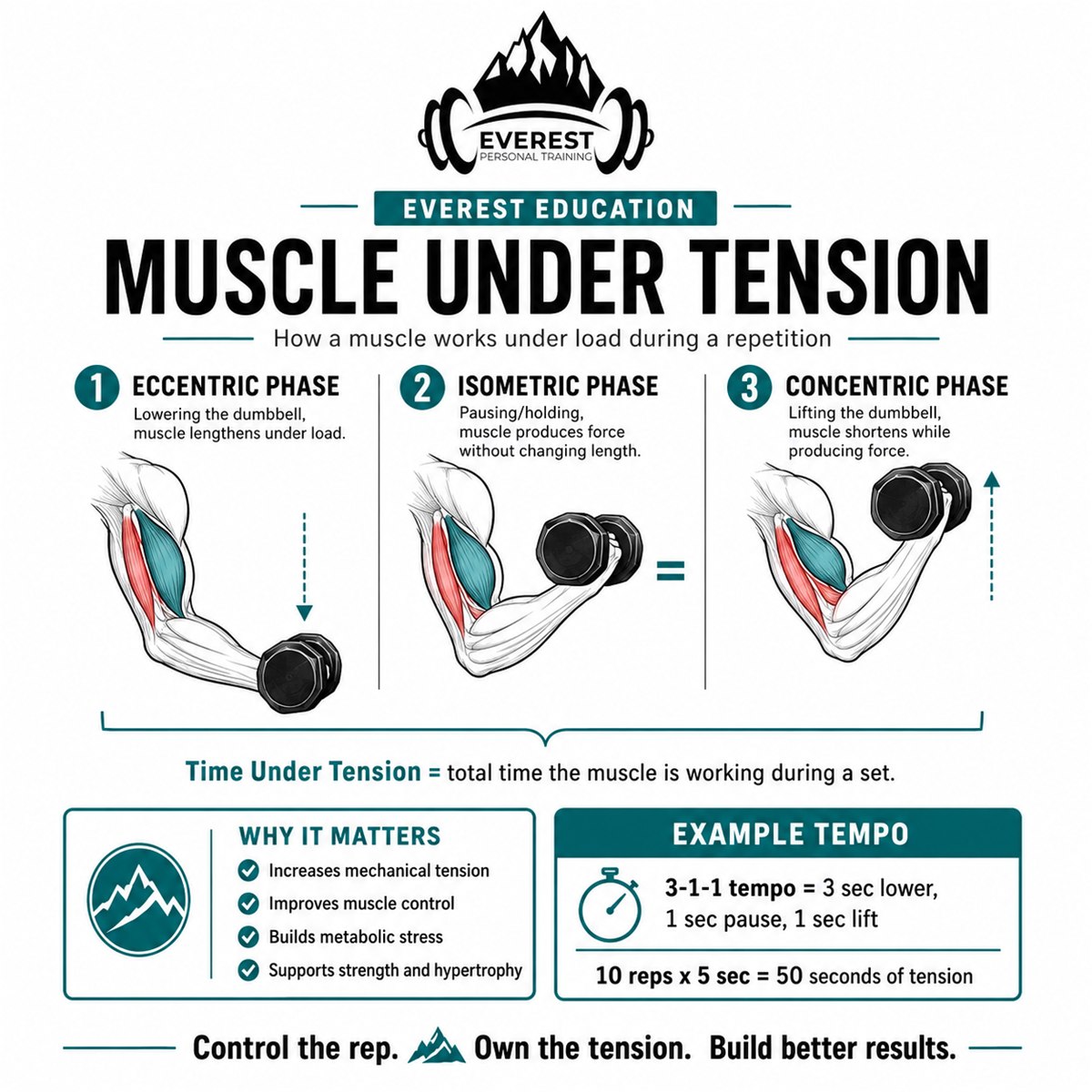
Time under tension is how long a muscle is actively producing force during a set. Every rep has three phases: eccentric (lowering), isometric (pause) and concentric (lifting). A 3-1-1 tempo means three seconds down, a one second pause and one second up, so ten reps produce around fifty seconds of tension. Slowing the eccentric phase improves control, technique, mechanical tension and motor unit recruitment, which means a controlled tempo can create a strong training stimulus without always needing maximal load.
Watch most people in a gym and you will see the same pattern: a controlled lift up, then the weight essentially dropped back down so the next rep can start. Half of every rep discarded, over and over, for years.
That lowering half is where a great deal of the adaptation lives.
What time under tension means
Time under tension is exactly what it sounds like: the amount of time a muscle is actively producing force during a set. Not how long the set takes, but how long the tissue is genuinely working.
Every repetition has three phases. The eccentric phase is the lowering, where the muscle lengthens under load. The isometric phase is the pause, where length does not change but force is still being produced. The concentric phase is the lift, where the muscle shortens.
Reading a tempo
Programmes often prescribe tempo as a string of numbers. A 3-1-1 tempo means three seconds lowering, a one second pause, then one second lifting.
Run ten reps at that tempo and you get roughly fifty seconds of time under tension. Run the same ten reps carelessly, dropping the weight each time, and you might get twenty. Same exercise, same load, same rep count, less than half the work.
Why slowing down works
Controlling the eccentric phase does several things at once.
It improves technique, because you cannot hide a poor position for three seconds the way you can for half of one. It increases mechanical tension, which is one of the primary drivers of muscle adaptation. It improves motor unit recruitment, meaning more of the muscle is genuinely participating. And it builds movement quality, because the nervous system gets time to learn the position rather than rushing through it.
The practical consequence is significant: a controlled tempo can create a strong training stimulus without always needing maximal load. That matters if you train at home, if you are returning from injury, or if you have hit a point where adding weight is no longer the sensible next step.
Why not slow everything down
Tempo is a tool, not a virtue. Grinding every rep of every set slowly limits how much load you can handle and how much total work you accumulate, and both of those matter too.
Good programming uses tempo deliberately, on the lifts and in the blocks where control is the thing you are trying to build, then gets out of the way when the priority is load or power.
What to do this week
- Take three seconds on the way down. Pick one main lift in your next session and control the eccentric properly.
- Pause where it is hardest. A one second hold at the bottom of a squat or the stretch of a row removes momentum entirely.
- Drop the weight to keep the tempo. If you cannot control the lowering, the load is the problem, not your patience.
- Note it in the app. Record the tempo you used so the next session has something to progress from.
- Use the cue. Lower with control, pause with intent, lift with power.
The Everest takeaway
Most people need better reps before they need heavier ones. The weight on the bar is a measure of what you lifted. The control is a measure of what you built.
Want tempo programmed properly rather than guessed at? Everest coached programmes prescribe tempo where it earns its place and track it session to session in the app. See the programmes.
Frequently asked questions
What does a tempo like 3-1-1 mean?
The numbers are seconds for each phase of the rep, in order: three seconds lowering, a one second pause at the bottom, then one second lifting. Ten reps at that tempo gives roughly fifty seconds of time under tension for the set.
Is slower always better for building muscle?
No. Slowing the lowering phase is a useful tool for control, technique and stimulus without heavy load, but grinding every rep slowly limits how much weight you can move and how much total work you do. Most programmes use tempo deliberately on some lifts rather than universally.
Can I build muscle with lighter weights?
Yes, if the set is genuinely challenging. Controlled tempo increases the time the muscle spends producing force, which is one way to make a lighter load demanding enough to drive adaptation. This is particularly useful when returning from injury or training with limited equipment.
Ready to put this into practice?
Whether you're starting out or chasing a goal, we'll point you to the right programme, coach or pathway.