Strength and Mobility: Why Yoga and Resistance Training Belong Together
Flexibility is the ability to access a range of motion. Mobility is the ability to actively control it. Strength training and yoga are not opposites: yoga develops body awareness, range, breath control, balance and tissue tolerance, while strength training builds load tolerance, muscle mass, tendon strength, joint stability and force production. Fascia, the connective tissue surrounding and linking muscles and joints, transmits force and coordinates movement across the body. Stretching opens the range; strength teaches the body to own it under load.
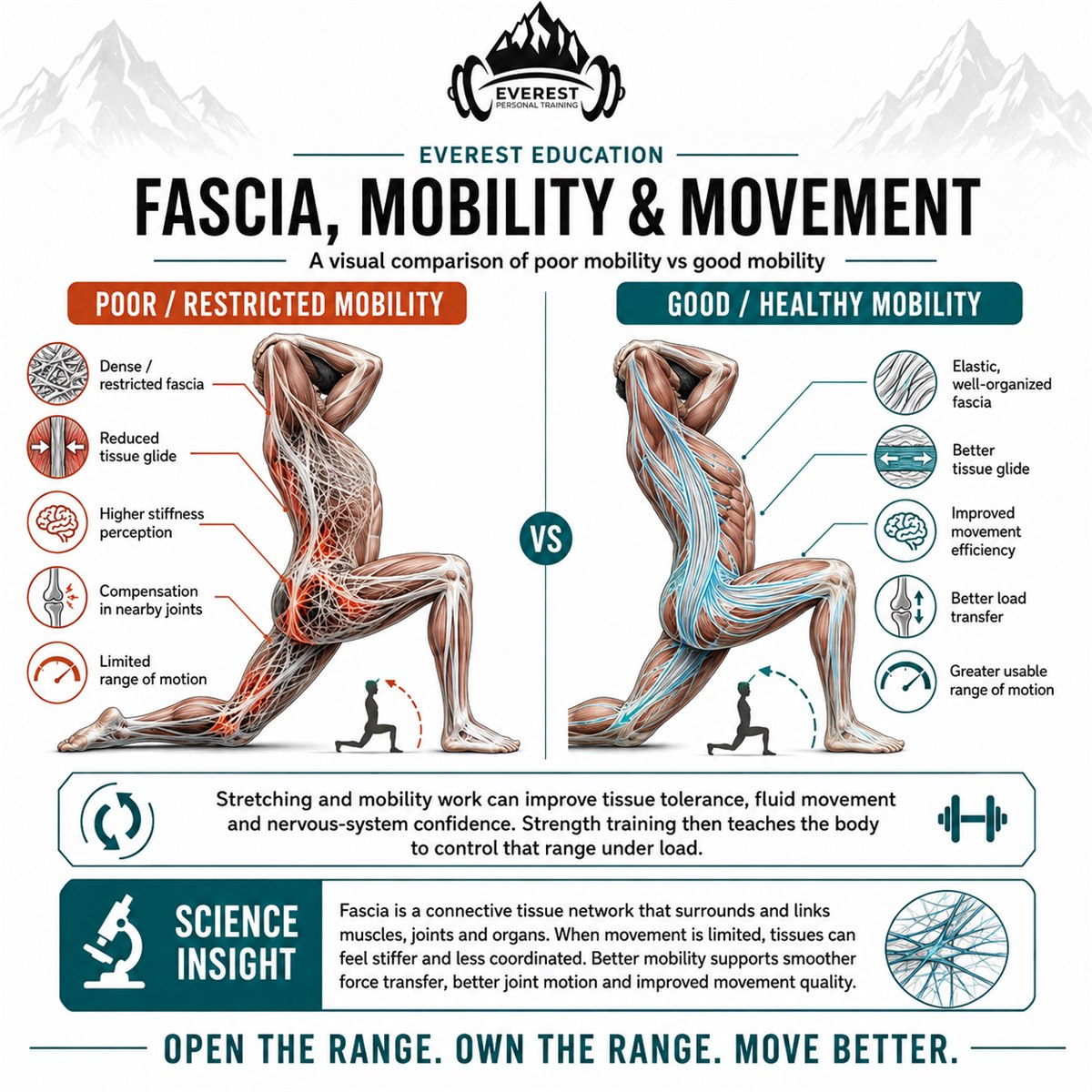
There is a stubborn belief that you have to pick a side. Lifters get stiff, the story goes, and yoga people get bendy but weak. Both halves of that are wrong, and the reason is worth understanding, because it changes how you should train.
Flexibility and mobility are not the same thing
Flexibility is the ability to access a range of motion. It is what someone measures when they push your leg towards your chest and see how far it goes.
Mobility is the ability to actively control that range yourself. It is what you can do with the range, not what can be done to you.
This distinction matters more than almost anything else in this article. You can be extremely flexible and have poor mobility, and that combination is associated with more injury risk rather than less. Range you cannot control is range you are exposed in.
What each side actually contributes
Yoga and mobility work develop body awareness, range of motion, breath control, balance, tissue tolerance and a parasympathetic recovery stimulus that hard training does not provide on its own.
Strength training builds load tolerance, muscle mass, tendon strength, joint stability and force production.
Look at those two lists and the overlap is almost zero. They are not competing approaches to the same outcome. They are answering different halves of the same question, which is how much your body can do and how well it can control doing it.
Where fascia comes in
Fascia is connective tissue that surrounds and links muscles, joints and organs. It is not a passive wrapper. It transmits force and helps coordinate movement across the body, which is part of why a restriction in one area shows up as a problem somewhere else entirely.
Better mobility supports tissue glide and gives the nervous system more confidence in a position. Strength through that same range teaches the body to own it under load. One without the other leaves the job half done.
Why this matters for how you train
A joint that can reach a position but cannot hold it under load is a joint waiting for the day something unexpected happens in that position. A joint that is strong only in a narrow middle range is fine until life asks for the edges.
The combination is what produces movement you can rely on. That is why Everest programmes pair strength work with mobility rather than treating stretching as a warm-up formality, and why Strength & Stretch exists as its own programme rather than as an afterthought.
What to do this week
- Add one yoga or mobility session. Once a week alongside your strength programme is enough to start.
- Lift through full range. Partial reps have their place, but a diet of them is where lifting-makes-you-stiff comes from.
- Load the end range. Deep squats, full-range rows, controlled lunges. Own the positions you want to keep.
- Breathe on purpose. Breath control transfers directly into bracing under load.
- Stop testing flexibility and start testing control. Can you actively hold the position you can passively reach?
The Everest takeaway
Stretching opens the range. Strength teaches the body to control it. You need both, and the order does not matter nearly as much as doing both.
Want them programmed together rather than bolted on? Strength & Stretch pairs resistance training with yoga in one weekly structure. Current pricing is confirmed during enquiry. See the programme.
Frequently asked questions
What is the difference between flexibility and mobility?
Flexibility is how much range you can passively access, like how far someone can push your leg. Mobility is how much of that range you can actively control under your own power. You can be very flexible and have poor mobility, and that combination is associated with more injury risk, not less.
Does lifting weights make you less flexible?
No. Resistance training through a full range of motion generally maintains or improves range. The stiffness people associate with lifting usually comes from training through short ranges, not from lifting itself.
Should I do yoga if I already strength train?
It complements strength work well. Yoga develops range, breath control, balance and body awareness, and it provides a parasympathetic recovery stimulus that hard training does not. One session a week alongside your programme is a reasonable place to start.
Ready to put this into practice?
Whether you're starting out or chasing a goal, we'll point you to the right programme, coach or pathway.