Muscle Protein Synthesis: Why Training, Protein and Recovery Must Work Together
Training does not build muscle during the session; it creates the signal. Muscle protein synthesis is the repair and rebuilding process that follows, and it runs alongside muscle protein breakdown constantly. You gain muscle when synthesis exceeds breakdown over time. Resistance training drives this through mechanical tension and cellular signalling, protein supplies the amino acids with leucine acting as a key trigger, and recovery determines whether the process completes. For most people that means 25 to 40g of protein per main meal, spread across the 24 to 48 hours after training rather than crammed into a narrow window.
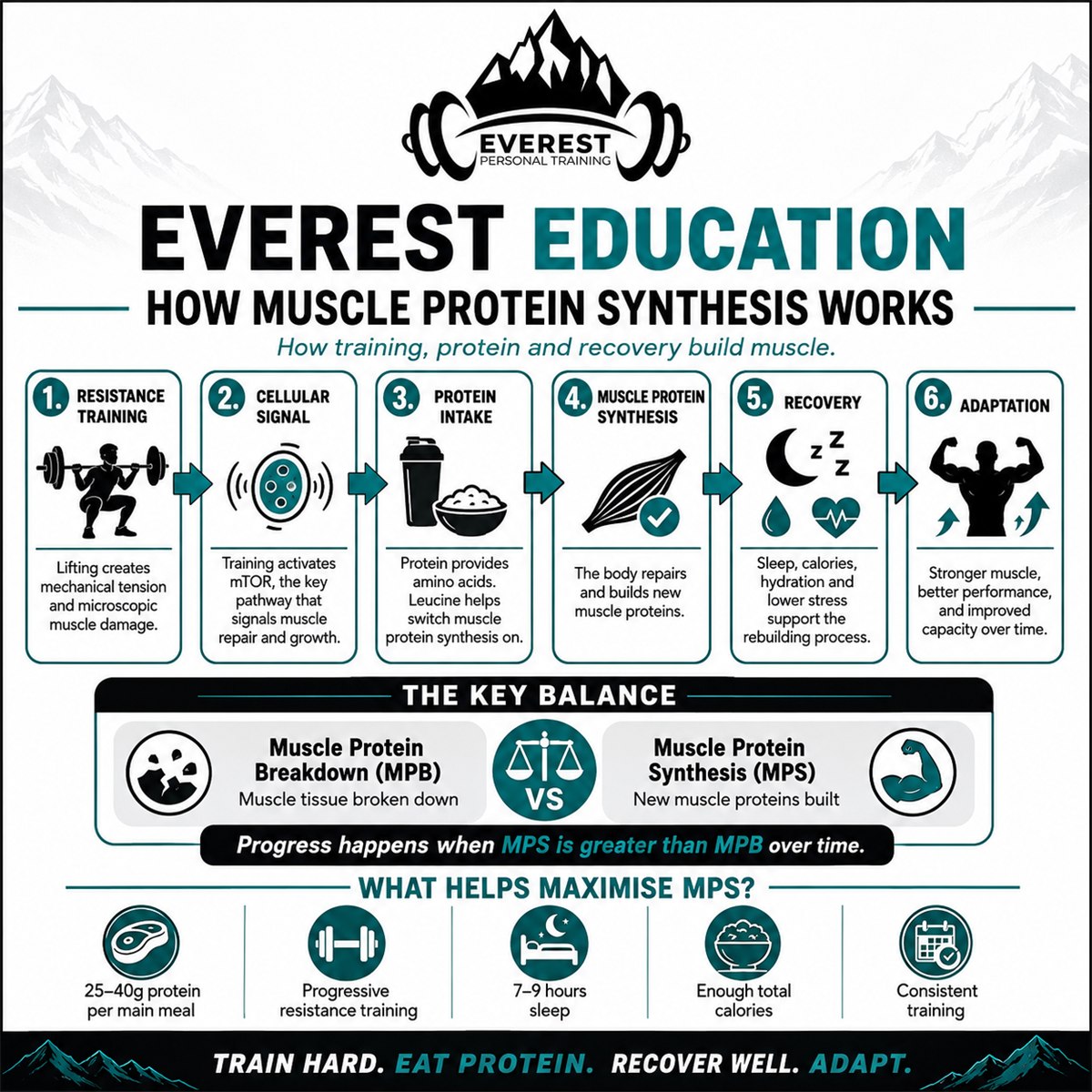
The most useful thing you can understand about building muscle is that it does not happen while you are training. The session is the instruction. The building happens later, mostly while you are asleep, and it depends almost entirely on what you do in the two days that follow.
The two processes running at once
Your muscle tissue is constantly being broken down and rebuilt. Muscle protein breakdown (MPB) and muscle protein synthesis (MPS) are both happening right now, every day, whether you train or not.
You gain muscle when synthesis exceeds breakdown across time. Not in a session, not on a day, but across weeks and months. That balance is the whole game, and everything below is a lever on one side of it.
What resistance training actually does
Lifting creates mechanical tension in the muscle and a degree of microscopic damage. That combination triggers cellular signalling, most notably through the mTOR pathway, which is the switch that tells the body to repair and grow.
This is why load and progression matter. A session that never challenges the tissue does not produce much of a signal, no matter how tiring it felt.
Where protein comes in
Signalling tells the body to build. Protein supplies the raw material to build with.
Dietary protein provides amino acids, and one of them, leucine, acts as an important trigger for muscle protein synthesis. Reach a sufficient dose of protein at a meal and you get a meaningful synthesis response. Come in well under it and you largely do not, which is why picking at protein across the day works less well than deliberate servings.
For most clients, 25 to 40g of protein per main meal is the practical anchor. That is roughly a palm-sized serve of meat or fish, a large serve of Greek yoghurt with a scoop of protein, or an equivalent from mixed plant sources.
Recovery is not the optional part
Muscle protein synthesis stays elevated for roughly 24 to 48 hours after a resistance session. That is a far wider window than the old thirty-minute panic suggested, and it changes the priority: what you eat across the next two days matters more than what you drink walking out of the gym.
Sleep, total calorie intake, hydration and stress load all affect whether that elevated window gets used. Underslept and underfed, you have the signal and no capacity to act on it.
What to do this week
- Hit 25 to 40g of protein at each main meal. Three or four solid servings beats grazing.
- Progress the load. A little more weight, one more rep, or better control than last time. The signal needs to keep meaning something.
- Protect your sleep. Seven to nine hours is where most of the rebuilding actually happens.
- Eat enough overall. You cannot build tissue in a large sustained deficit and expect it to go well.
- Think in days, not minutes. Judge your protein across the 48 hours after a session, not the 30 minutes.
The Everest takeaway
Train hard, eat protein, recover well, adapt. Every one of those four is load-bearing. Remove any one and the other three stop compounding.
Want the protein side handled properly? Everest programmes come with nutrition habits built around your training week, tracked in the app alongside your sessions. See the programmes.
Frequently asked questions
How much protein do I need to build muscle?
Most people do well with 25 to 40g of protein per main meal, spread across the day. Total daily intake matters more than the timing of any single serve, and spreading it evenly gives you more opportunities to raise muscle protein synthesis than saving most of it for dinner.
Is there an anabolic window after training?
Not the narrow one that was popular for years. Muscle protein synthesis stays elevated for roughly 24 to 48 hours after a resistance session, so the meals across the next two days matter more than getting a shake in within thirty minutes.
Do I build muscle during the workout?
No. The workout creates mechanical tension and cellular signalling that tells the body to adapt. The actual rebuilding happens afterwards, during recovery, and depends on having enough protein, enough total calories and enough sleep.
Ready to put this into practice?
Whether you're starting out or chasing a goal, we'll point you to the right programme, coach or pathway.